Free Speech and Flag Burning

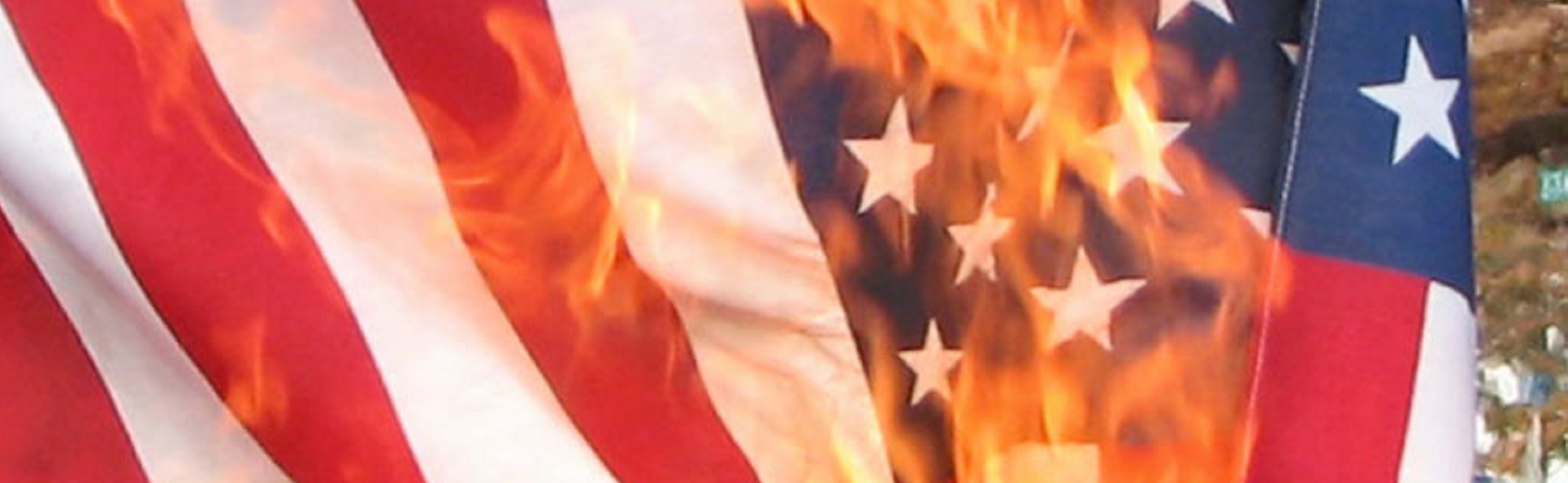
After Donald Trump was elected president the first time in 2016, and before he even took office, there were protests on some college campuses in which American flags were burned. Trump responded with righteous indignation: “Nobody should be allowed to burn the American flag — if they do, there must be consequences — perhaps loss of citizenship or year in jail!” He subsequently reiterated this idea — to applause and chants of “USA! USA!” — at rallies filled with the conservative faithful.
Although a constitutional amendment to prohibit the desecration of the American flag was soon after introduced in Congress, it suffered the same fate as similar previous amendments and went down in flames.
A constitutional amendment to prohibit flag burning was required because the Supreme Court had ruled in the case of United States v. Eichman (1990) that the Flag Protection Act of 1989 was unconstitutional because flag burning was expressive conduct protected by the First Amendment. The act criminalized the conduct of anyone who “knowingly mutilates, defaces, physically defiles, burns, maintains on the floor or ground, or tramples upon” an American flag.
Now that Trump is the president again, he is going after flag burning with a vengeance. He recently issued an executive order titled “Prosecuting Burning of the American Flag.” It says in part:
Notwithstanding the Supreme Court’s rulings on First Amendment protections, the Court has never held that American Flag desecration conducted in a manner that is likely to incite imminent lawless action or that is an action amounting to “fighting words” is constitutionally protected.
My Administration will act to restore respect and sanctity to the American Flag and prosecute those who incite violence or otherwise violate our laws while desecrating this symbol of our country, to the fullest extent permissible under any available authority.
To the maximum extent permitted by the Constitution, the Attorney General shall vigorously prosecute those who violate our laws in ways that involve desecrating the American Flag, and may pursue litigation to clarify the scope of the First Amendment exceptions in this area.
This executive order will appeal to Christian nationalists and “God and Country” Christian bumpkins who think that Lee Greenwood’s “God Bless the U.S.A” should be the national anthem.
I know what the Supreme Court says, but it has been wrong before. Flag burning should not be a First Amendment issue because flag burning is not free speech.
The First Amendment reads as follows:
Congress shall make no law respecting an establishment of religion, or prohibiting the free exercise thereof; or abridging the freedom of speech, or of the press; or the right of the people peaceably to assemble, and to petition the Government for a redress of grievances.
Clearly, the First Amendment protects the individual rights to freely exercise one’s religion, speak freely, publish freely, peaceably assemble, and petition the government.
But two things should be noted. First, the First Amendment protects these acts from infringement by the federal government, not the state governments. This means that the state governments may pass laws against flag burning. And second, the First Amendment has nothing to do with flag burning, which also means that the state governments may pass laws against flag burning.
The federal government cannot pass laws against flag burning, but not because flag burning is symbolic speech or expression protected by the First Amendment. Rather, it cannot do so because it has been granted no authority by the Constitution to prohibit, regulate, or hinder the burning, desecration, or destruction of a flag or any other piece of cloth — even if it is red, white, and blue with stars and stripes.
If flag burning is to be a crime, then it must, like the vast majority of all other crimes, be a crime on the state level. But it should be a crime only if you burn a flag without permission that is not yours or you burn a flag without permission on property that is not yours.
So, the next time you see someone burn an American flag, just ask two questions: (1) Whose flag? and (2) Whose property? The real issues are theft and trespassing, not whether the sight of someone burning a flag is offensive or unpatriotic.
The real danger to Americans—as John Whitehead has said—isn’t someone burning the flag; it is the government torching the Constitution.
The post Free Speech and Flag Burning appeared first on The Future of Freedom Foundation.
