10 Weekend Reads

The weekend is here! Pour yourself a mug of Danish Blend coffee, grab a seat outside, and get ready for our longer-form weekend reads:
• In the Shadow of Jane Street and Citadel Securities, Hudson River Mints Billions: The quiet flash boy has morphed into a powerhouse among non-bank market makers. (Bloomberg free)
• In every corner of the country, the middle class struggles with affordability. The nation’s affordability crisis has not spared middle-class families, one-third of which struggle to afford basic necessities such as food, housing, and child care. Across the 160 U.S. metro areas studied, at least 20% of middle-class earners cannot afford to live in that place, after adjusting for local income ranges and price variations. The share of struggling middle-class families varies by race: 27% of white families, 39% of Black families, 41% Asian, 46% Native American, and 50% of Latino are unable to afford basic necessities. (Brookings) see also ‘The New Price of Eggs.’ The Political Shocks of Data Centers and Electric Bills: Democrats zeroed in on utilities and affordability to win Republican support in upset elections in Georgia and Virginia. Can the same playbook work in 2026? (New York Times)
• When Donald Trump Fired David Rubenstein: The private-equity billionaire spent decades building influence in the capital. Then his philanthropy collided with the president. (The Atlantic)
• The Airport-Lounge Wars: When you’re waiting for a flight, what’s the difference between out there and in here? (New Yorker)
• Is Gen X Actually the Greatest Generation? (no): How one era changed everything about the culture — and why we’re so nostalgic for its creations. (New York Times Magazine)
• Ozempic is changing how we spend money and time, plus what we eat: In just over a year, the percentage of U.S. adults taking drugs such as Ozempic, Wegovy, Mounjaro and Zepbound more than doubled to 12.4 percent, according to Gallup. The survey also reported that the obesity rate fell from almost 40 percent in 2022 to 37 percent in 2025. Some companies are already responding by acquiring health food brands, renovating hotel gyms and changing lunch menus. But that’s only scratching the surface, said Diana Melencio, a partner at XRC Ventures, an early-stage venture capital firm. (Washington Post) see also Ozempic and Other GLP-1s Are Now Being Marketed to People Who Aren’t Obese: “You don’t need to be obese to start a GLP-1,” reads an ad from a telehealth startup, the words scrawled in icing on a cake. Another one features a slender woman excited to lose a little weight before her wedding. Yet another says patients can drop 17 pounds in two months by microdosing copycat Ozempic. (Bloomberg) see also Calories In, Calories Out is Preventing You From Understanding Ozempic. People are more likely to talk about GLP-1s as appetite suppressants that happen to have a lot of mysterious, incomprehensible side effects. Why, they ask, do the brain, the heart, the reproductive system, and other organs seem to respond to GLP-1s, sometimes in the absence of significant weight loss? (Eurydice Lives)
• The New German War Machine: After World War II, Germany embraced pacifism as a form of atonement. Now the country is arming itself again. (The Atlantic)
• The Oceans Are Going to Rise—but When? The uniquely vulnerable West Antarctic Ice Sheet holds enough water to raise global sea levels by 5 meters. But when that will happen—and how fast—is anything but settled. (Wired)
• A Mechanistic Framework for Targeted Intervention in Single-Gene Mental Illness: The statistical signatures are unambiguous: individuals carrying GRIN2A: loss-of-function variants face an 87-fold increased hazard ratio for psychotic disorders, 11.8-fold for anxiety disorders, and 5.84-fold for depressive disorders relative to the general population. The GRIN2A Paradigm: Monogenic Psychiatry and the Precision Phytochemical Revolution. (Shanaka Anslem Perera)
• Why One Man Is Fighting for Our Right to Control Our Garage Door Openers: If companies can modify internet-connected products and charge subscriptions after people have already purchased them, what does it mean to own anything anymore? (New York Times)
Be sure to check out our Masters in Business interview this weekend with Paul Zummo, Chief Investment Officer and Co-founder of JPMorgan Alternative Asset Management. The JPM group manages $35 billion in external hedge fund solutions for institutional and high-net worth investors. He also heads the Portfolio Management Group, and is a member of the JPMAAM Investment Committee.
How much equity are founders selling to VCs per round
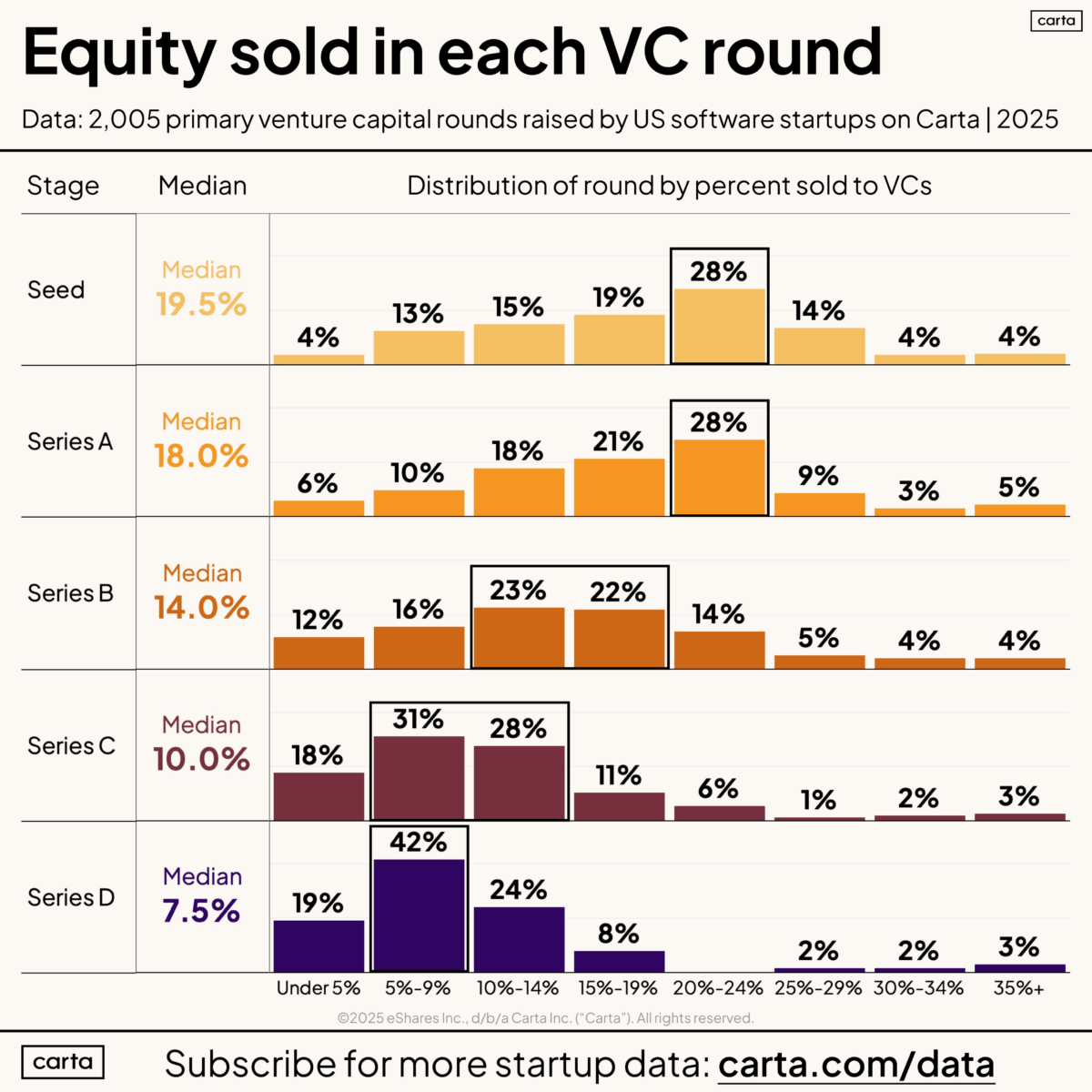
Source: @PeterJ_Walker
Sign up for our reads-only mailing list here.
~~~
To learn how these reads are assembled each day, please see this.
The post 10 Weekend Reads appeared first on The Big Picture.
