A Neuro-Symbolic Architecture for Industrial Cognition

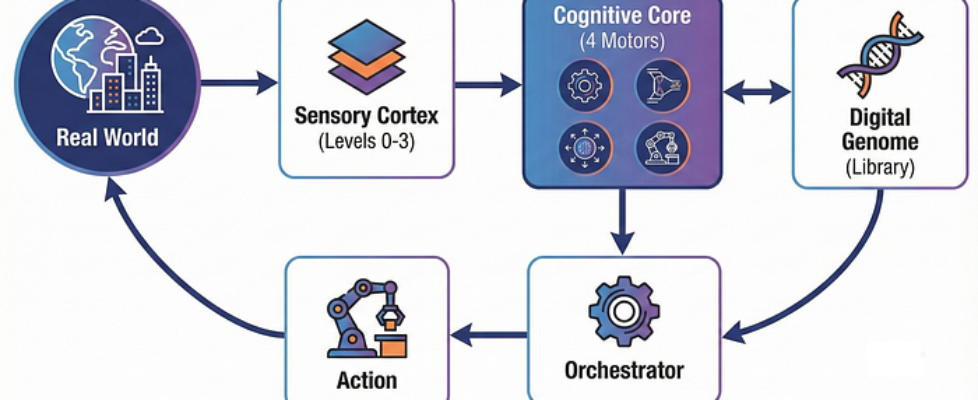
Author(s): Carlos Eduardo Favini Originally published on Towards AI. By Carlos Eduardo Favini Industrial AI — Image by Author 1. The Semantic Ceiling: Why Industrial AI Stalls After two decades of investment, roughly 70% of digital transformation initiatives fail to scale beyond pilot stages (McKinsey, 2023). Industry 4.0 delivered connectivity — sensors, networks, data lakes — but not cognition. The result: dashboards that monitor but don’t decide, models that predict but don’t understand, and automation that breaks when context shifts. The core problem is architectural. Current systems process data types — predefined categories like “image,” “text,” or “sensor reading.” But operational reality doesn’t arrive in neat categories. A technical drawing encodes spatial intention. A gesture encodes operational command. A vibration pattern encodes mechanical state. These aren’t “data types” — they are signals carrying semantic potential. To move from connectivity to cognition, we need an architecture that can perceive signals regardless of format — including formats that don’t yet exist. It must extract intention from structure, not just pattern from data. It must evaluate decisions through multiple cognitive lenses simultaneously. And it must learn and evolve operational knowledge over time. This article presents such an architecture — a neuro-symbolic framework that bridges the gap between raw signals and intelligent action. 2. The Sensory Cortex: Carrier-Agnostic Perception The first innovation is a perception layer that separates what carries a signal from what the signal means. We call this the Sensory Cortex. Traditional systems ask: “What data type is this?” The Sensory Cortex asks: “Is there structure here? And if so, does that structure carry intention?” This reframing enables processing of signals that weren’t anticipated at design time — a critical capability for industrial environments where new sensor types, protocols, and formats emerge continuously. The Abstraction Hierarchy The Sensory Cortex operates through five levels of abstraction: Level 0 — Carrier: The physical or digital substrate transporting the signal. Electromagnetic (light, radio), mechanical (vibration, pressure), chemical (molecular), digital (bits), or unknown. Level 1 — Pattern: Detectable regularities within the carrier. Spatial structures (2D, 3D, nD), temporal sequences (rhythm, frequency), relational networks (graphs, hierarchies), or hybrid combinations. Level 2 — Structure: Non-random organization suggesting information content. Repetition, symmetry, compressibility — entropy below noise threshold indicating that something meaningful exists. Level 2.5 — Proto-Agency: The critical bridge between structure and meaning. Does the structure suggest encoded agenda? This is not meaning itself, but the suspicion that meaning exists. Indicators include functional asymmetry (purposeful interruption of symmetry), oriented compression (patterns that “point” toward something), transform invariants (persistence across carrier changes), and apparent cost (structure too expensive to arise by chance). Level 3 — Semantics: If proto-agency is detected, attempt meaning extraction. The key question is not “what is this?” but “what does this allow to be done?” The concept of Proto-Agency (Level 2.5) is novel. Traditional systems jump directly from “pattern detected” to “meaning assigned.” The Sensory Cortex introduces an intermediate step: detecting the suspicion of intention before attempting interpretation. This prevents false semantic attribution to random structure while enabling recognition of genuinely purposeful signals. Figure 1: The Abstraction Hierarchy in the Sensory Cortex. Note the critical ‘Proto-Agency’ bridge between raw structure and semantic meaning. — Image by Author Implementation: The SensoryCortex Class from dataclasses import dataclassfrom enum import Enumfrom typing import Optional, Dict, Anyimport numpy as npclass CarrierType(Enum): ELECTROMAGNETIC = “electromagnetic” MECHANICAL = “mechanical” DIGITAL = “digital” UNKNOWN = “unknown”@dataclassclass PerceptionResult: carrier: CarrierType pattern_type: str structure_score: float # [0,1] non-randomness proto_agency_score: float # [0,1] suspicion of intention semantic_potential: Optional[Dict[str, Any]] = Noneclass SensoryCortex: “””Carrier-agnostic perception layer.””” def perceive( self, signal: bytes, metadata: Dict = None) -> PerceptionResult: carrier = self._detect_carrier(signal, metadata) pattern = self._extract_pattern(signal, carrier) structure_score = self._analyze_structure(pattern) proto_agency = self._detect_proto_agency(pattern, structure_score) semantics = None if proto_agency > 0.6: # Threshold for semantic extraction semantics = self._extract_semantics(pattern, carrier) return PerceptionResult( carrier, pattern.type, structure_score, proto_agency, semantics) 3. The Cognitive Core: Four Parallel Motors Once signals are perceived and semantics extracted, decisions must be made. Traditional systems evaluate decisions sequentially: safety check → governance check → inference → selection. This creates bottlenecks and loses critical information about why a decision is good or bad from different perspectives. The Cognitive Core takes a different approach: four specialized “motors” evaluate every input simultaneously, each providing a score from a distinct cognitive lens: Praxeological Motor: Does this action realize its intention? This motor evaluates means-end coherence, asking whether the proposed action actually achieves the stated goal. It is rooted in the logic of purposeful human action — the science of what works. Nash Motor: Does this produce equilibrium? In complex systems, multiple stakeholders have competing objectives: production versus safety, short-term efficiency versus long-term maintenance. This motor finds Nash equilibria — stable states where no party can improve their position unilaterally. Chaotic Motor: Is this robust to perturbation? Small changes can cascade into catastrophic failures. This motor performs sensitivity analysis, identifies strange attractors, and maps failure modes before they manifest. Meristic Meta-Motor: What patterns exist across scales? Operating simultaneously at micro, meso, and macro levels, this motor detects recurring structures, generates variant hypotheses, and imagines what should exist but doesn’t yet. It proposes but never decides — creativity under containment. 4. Craft Performance: Product, Not Sum The four motors produce scores in the interval [0,1]. How should these be combined into a single decision metric? The intuitive approach is weighted averaging: CP = 0.3×P + 0.3×N + 0.2×C + 0.2×M. This approach is fundamentally wrong. Consider this scenario: the Praxeological score is 0.95 (excellent intent alignment), the Nash score is 0.90 (good equilibrium), the Chaotic score is 0.85 (robust to perturbation), but the Meristic score is 0 (the Meta-Motor detects a fundamental pattern violation that the other motors missed). The weighted average would be approximately 0.68. The system would proceed with what appears to be a “moderately good” decision. But any motor scoring zero represents a categorical rejection. No amount of excellence in three dimensions compensates for fundamental failure in one. This is what I call the “yen example”: if you […]
