Donald Trump and the Alt-Right

For years Donald Trump had no more committed a MAGA supporter than Rep. Margaret Taylor Greene of Georgia.
As a private citizen, she had been fervently loyal to Trump during all the troubles and setbacks of his first term.
Greene was then elected to Congress in 2020 and upon taking office fully endorsed Trump’s claims of a stolen election and his efforts to have it overturned. Just days later, the January 6, 2021 storming of the Capitol by a mob of outraged Trump supporters prompted many to denounce him as an insurrectionist, with numerous prominent Republicans joining that chorus of condemnation.
After that incident, Trump was immediately purged from Twitter, losing direct access to his tens of millions of erstwhile followers and crippling his influence. But Greene never wavered, and her loyalty to Trump soon led to a House vote removing her from all her committee roles, effectively eliminating most of her Congressional responsibilities.
During 2023 many dozens of felony charges were filed against Trump, with the four separate criminal prosecutions taking place in fiercely anti-Trump localities, whose juries were expected to convict him. As a result, most political analysts wrote off the former president as a political has-been, much more likely to end up financially bankrupt and in a prison cell than with any chance of regaining the White House in 2024. Indeed, many of the committed right-wing activists who had constituted Trump’s base shifted their support in the 2024 race to Florida Gov. Ron DeSantis, believing that he had a much better chance of winning the presidency and enacting elements of Trump’s agenda because he lacked the latter’s heavy political baggage.
But Greene stayed loyal, and her 28,000 word Wikipedia page never even mentions DeSantis, nor Nicki Haley, the former Trump official also widely promoted as a leading candidate in the 2024 primaries.
However, all of this began to change earlier this year, as Greene became more and more openly critical of many of Trump’s current policies. The flashpoint was the complete reversal on his longstanding pledge to release all the Jeffrey Epstein documents. So about a month ago Tucker Carlson interviewed Greene for thirty minutes regarding her growing break with Trump, preceding their discussion with his own hour-long monologue on the MAGA movement and its ideological principles.
I’d always vaguely regarded MAGA—“Make America Great Again”—as merely a populist, right-wing slogan devoid of any substantive meaning, and indeed the 10,000 word Wikipedia article seems to suggest exactly that. But Carlson instead insisted that Trump’s ideological movement had clear principles, being based upon what he described as the Five Pillars of MAGA, which I’d summarize as follows:
- Putting the Interests of America First in Foreign Policy and Everything Else
- America Must Control Its Borders and Build a Wall
- No More Unnecessary Foreign Wars
- Stop Globalization and Bring Manufacturing Jobs Back to America
- Stop Censorship and Protect Free Speech
However, whether or not those fundamental pillars of the Trump MAGA movement may have existed, the actual policies implemented suggest that Trump himself was completely unaware of these.
For example, just a few weeks after Trump’s second inaugural I highlighted one of the most shocking actions taken by the new administration:
A 30-year-old Tufts doctoral student and Fulbright Scholar from Turkey was walking across her Boston-area neighborhood on the way to a holiday dinner at a friend’s house when she was suddenly seized and abducted in the early evening by six masked federal agents of the Department of Homeland Security. The terrified young woman was handcuffed and taken to a waiting car, secretly detained for the next 24 hours without access to friends, family, or lawyers, then shipped off to a holding cell in Louisiana and scheduled for immediate deportation, although a federal judge has now temporarily stayed the proceedings.
Just one of the Tweets showing a short clip of that incident has been viewed more than 4.5 million times, with a much longer YouTube video accumulating another couple of hundred thousand views.
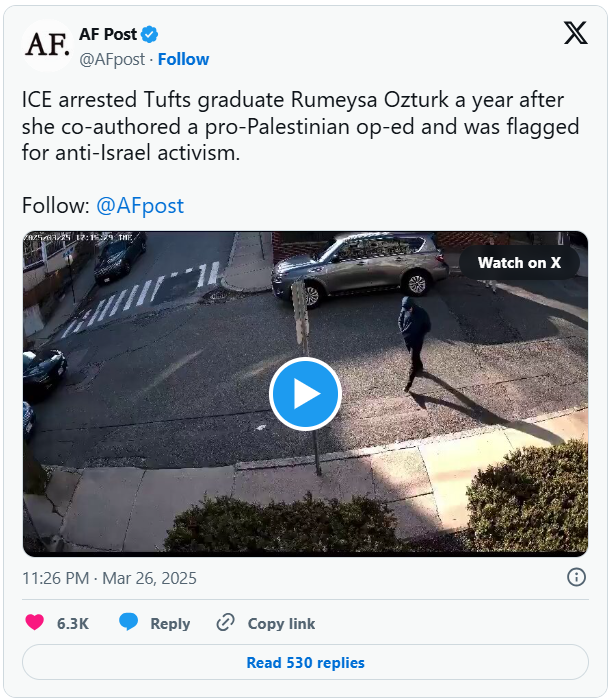
That very disturbing scene seemed like something out of a Hollywood film chronicling the actions of a dystopian American police state, and that initial impression was only solidified once media reports explained why Rumeysa Ozturk was snatched off the streets of her home town. Her only reported transgression had been her co-authorship of an op-ed piece in the Tufts student newspaper a year earlier sharply criticizing Israel and its ongoing attacks on the civilian population of Gaza.
Apparently, one of the many powerful pro-Israel censorship organizations funded by Zionist billionaires became outraged over her sentiments and decided to make a public example of her, so its minions in the subservient Trump Administration immediately ordered her arrest.
- The Zionist Destruction of American Higher Education
Ron Unz • The Unz Review • March 31, 2025 • 7,300 Words
Snatching legal permanent American residents off our city streets because they had once been critical of the policies of a foreign government seemed to violate more than half of the alleged MAGA principles, and this pattern certainly continued during the months that followed.
Despite the intense lobbying of both Carlson and influential TPUSA leader Charlie Kirk, Trump later attacked Iran at the obvious behest of the Israel Lobby, which seemed to exercise even greater influence over his administration than it ever had over previous ones. Kirk’s strong disillusionment with the Israeli control over our government was soon followed by his extremely suspicious assassination, then by more recent claims that the FBI investigation may have been severely circumscribed while efforts by other administration figures to get at the truth of what happened were completely blocked.
So while someone like Rep. Greene had been completely committed to the MAGA agenda, the president she followed was not, and as a staunch believer in the ideals of “America First,” she began expressing her outrage that our own government had apparently fallen under the control of partisans serving a foreign nation. Tens of millions of Americans had voted for MAGA but they instead got MIGA—“Make Israel Great Again.”
This has hardly been the only example of MAGA failures or betrayals at the hands of our erratic president.
The bizarre, almost random nature of Trump’s “Liberation Day” tariffs and the rapid reversal that followed seemed very unlikely to shift substantial numbers of manufacturing jobs back to America. Major business investment decisions require confidence in long-term stability, and with Trump dramatically changing his tariff policies apparently by personal whim on a monthly, weekly, or even daily basis, none of that exists.
Over the last few weeks, Trump has regularly denounced Venezuelan President Nicolás Maduro as a notorious drug-dealer while providing no evidence to substantiate such accusations. These seemed aimed at justifying a looming American military attack against that country, with former Trump ally Col. Douglas Macgregor recently arguing that such a war will cost him his presidency. Then just a couple of days ago, Trump pardoned former Honduran President Juan Orlando Hernández, who had been convicted for drug-dealing by an American jury in 2024 and sentenced to 45 years in federal prison for flooding our country with 500 tons of cocaine over twenty years.
Soon after Greene’s appearance on Carlson’s show, Trump angrily denounced her and promised to support a Republican challenger in her district. More importantly, she began receiving numerous death-threats directed against herself and her family. Perhaps mindful of Kirk’s fate, she announced that she would resign from Congress in January.
Although all American presidents since Lyndon Johnson have been firmly pro-Israel, the Trump Administration has taken that policy to an absurd, almost cartoonish extent.
Earlier this year, Mike Huckabee, the American ambassador to Israel, had a long and friendly meeting with Jonathan Pollard, perhaps the most notorious traitor in recent American history, and neither Trump nor any of this officials seemed to take serious offense at that decision.
Meanwhile, one of the most forceful domestic policies pursued by Trump’s appointees has been their major campaign to combat antisemitism across our universities and the rest of our society, with the term usually so broadly defined as to encompass almost any criticism of Israel or Jews.
About a month ago, a political scientist named Laura K. Field published Furious Minds, a 400 page volume released by Princeton University Press analyzing the MAGA movement of President Donald Trump. Her work drew a long list of very favorable reviews and blurbs, from the New York Times on down and was even named a Financial Times Book of the Year.
But although her work was intended to be a guide to the beliefs permeating Trump’s political movement of the last few years and his current administration, she also naturally discussed the circumstances of Trump’s first presidential race. During that campaign, his candidacy was heavily associated with the Alt-Right movement, whose large and energetic presence on social media and the rest of the Internet may have helped him overcome all of Hillary Clinton’s huge traditional advantages in mainstream media support, political endorsements, and a far larger advertising budget.
Yet oddly enough, that Alt-Right movement was widely perceived as extremely critical of Jewish influence and Israel, with many of its leading figures expressing strongly antisemitic or even neo-Nazi beliefs.
The Alt-Right collapsed years ago and has no real connection with Trump’s current policies or personnel. But at the time, it had provoked an enormous amount of public attention, probably far more than any focus on MAGA. So before analyzing those latter ideas, I decided to first reexamine the very different group of activists and ideologues who had been so strongly identified with Trump’s 2016 race, a movement that I’d casually followed at the time but never investigated in any detail.
In her discussion, Field had repeatedly cited the work of George Hawley, a professor at the University of Alabama who had apparently become something of an academic expert on the Alt-Right, so I ordered and read his books, beginning with Right-Wing Critics of American Conservativism. Published by the University Press of Kansas, that 2016 volume seemed to have established his reputation as an authority on far right political movements, laying the basis for his subsequent books on the Alt-Right.
Hawley covered the origins of modern American conservativism and the many challenges it had faced over the years from the right, with his account generally following a rather conventional narrative.
After briefly discussing the Old Right of the pre-World War II era, he explained how William F. Buckley Jr. had essentially created modern American conservativism by founding National Review in 1955. Next, he recounted Buckley’s generally successful efforts to purge his mainstream conservative movement of various factions that he considered extremist or otherwise disreputable, including the highly conspiratorial John Birch Society and Ayn Rand’s libertarian Objectivists.
Following this introductory treatment, Hawley then devoted individual chapters to some of the other right-wing ideological challengers that mainstream conservatives had faced over the decades, including the “Localism” movement, libertarians, radical libertarians, and the Paleoconservatives of the 1990s. With the exception of his coverage of the “Localists”—who seemed rather unimportant to me—none of this material was new or ground-breaking, merely reflecting a traditional narrative presented in numerous other books that I had read over the years.
I noticed that no chapter was devoted to the Neocons, although the policies advocated by those former liberals and leftists were at least as divergent from the mainstream conservative movement as those groups that he had included. One of the most popular right-wing books of the 1960s was None Dare Call It Treason, with the title drawn from the famous epigram of an Elizabethan courtier pointing out that if traitors or rebels succeed in their enterprise, they inevitably rewrite history to conceal what had happened. And since the Neocons successfully seized control of the mainstream conservative movement during the 1980s and 1990s, purging any who opposed them, they were extensively discussed in Hawley’s text but unlike the other rebellious factions, no chapter was allocated to their successful coup.
Although most of his coverage seemed fine, some of Hawley’s rather blatant errors did jump out at me. For example, he repeatedly misidentified the very influential Gentile libertarian economist and Nobel Laureate Friedrich Hayek as a secular Jew. And although the author correctly explained that Buckley had based his conservatism upon Frank Meyer’s fusion of the three separate strands of free market economics, a hawkish anti-Communist foreign policy, and traditional social values, Hawley always misspelled it as “Fushionism,” a non-existent term rather than the “Fusionism” that it has always been called. These sorts of items suggested that the author lacked any deep knowledge of the ideological movement whose history he was describing.
A much more serious problem with Hawley’s account was one that he shared with nearly all previous histories of the conservative movement, which he had obviously used as his sources. These latter were almost invariably based in that ideological milieu, so much so that his discussion of the right-wing challenges that conservatism had faced was a little like using Stalinist tracts as the starting point for an analysis of Trotskyism.
This was not a major problem when author focused on libertarians or Paleoconservatives since he would then consider their own writings. But I think he seriously missed the boat with regard to earlier periods from the 1950s or the 1960s, failing to realize that later conservative chroniclers might have deliberately ignored or downplayed some important right-wingers whom they or their own earlier sources had regarded as too dangerous to discuss. After all, if conservatives had successfully thrown their early opponents down the memory-hole, the last thing they wanted was to resurrect such past ideological foes and bring them to the attention of later writers.
Consider, for example, Prof. Revilo P. Oliver, a distinguished classics scholar, who only received a single brief mention, one that casually dismissed him as a minor early conservative figure jettisoned for his antisemitism. Such a characterization was exactly how he has almost invariably been portrayed in mainstream conservative histories if they even bothered to mention him at all. But this is far from accurate, and by blindly relying upon such accounts, the author was merely repeating such severe distortions. During World War II, Oliver had headed an important American code-breaking division and then later served as one of the leading early figures in both National Review and the John Birch Society during the 1950s and 1960s, afterwards spending decades as a highly influential figure in far right circles prior to his 1994 death.
The fiercely atheistic and antisemitic Oliver had long been personally close to Buckley, having been a member of the latter’s 1950 wedding party—according to Paul Gottfried even serving as his best man—and his 1981 memoirs America’s Decline included some shocking facts about the early conservative movement. According to Oliver, National Review had originally been founded with the explicit, secret goal of combatting Jewish influence in American society. In support of that dramatic claim, we know that the largest portion of the initial funding came from Buckley’s own very wealthy father, who was notorious for his ferocious antisemitic sentiments. Oliver also claimed that the John Birch Society had been founded a few years later with exactly that same secret, antisemitic agenda. But Oliver explained that funding difficulties soon forced both those conservative organizations to desperately seek the support of major Jewish donors and therefore completely abandon those original goals, which they naturally did their best to conceal.
I summarized this remarkable first-hand account in a 2019 article, and whether or not Hawley would have credited Oliver’s stories, he certainly should have included the latter’s memoirs among his important source materials.
An even more serious omission came with regard to Prof. John Beaty’s 1951 volume The Iron Curtain Over America, which went through some 17 printings and reportedly became the second bestselling conservative book of the 1950s. Like Oliver, Beaty was a well-regarded academic scholar and during World War II he had held one of our most crucial positions in Military Intelligence, being responsible for producing the daily briefing reports provided to the White House and all our other top military and political leaders. Once again, both Beaty and his huge conservative bestseller have been totally removed from almost all our conservative histories, and Hawley seemed completely unaware of either the man or his book.
The reason for Beaty’s total purge from conservative memory is hardly mysterious. Although he himself was a strong anti-Communist and a devout Christian of rather moderate views, his central wartime role and his subsequent years of research led to his explosive account of the enormous but hidden role of Jewish organizations in our political life and our involvement in the war, and his dramatic claims were strongly endorsed by a long list of top generals and influential U.S. senators. The title of his book referred to the “iron curtain” of Jewish media control that had descended upon American society, and it seemed likely that Beaty’s analysis of that growing problem may have helped prompt the founding of National Review a few years later.
The post Donald Trump and the Alt-Right appeared first on LewRockwell.
