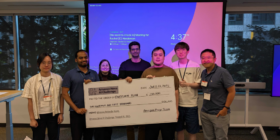
How a French Spirits Company Created Employee Buy-In for AI
Pernod Ricard used four strategies to quell skepticism and convince people of its value.
Background: Automated visual field testing is fundamental in ophthalmology, but differences in stimulus scaling and luminance between devices hinder direct comparison of sensitivity values. Virtual reality (VR)–based perimetry has emerged as a portable alternative, yet its relationship with conventional perimetry requires clarification. Methods: This prospective cross-sectional study included 60 healthy participants stratified into younger (< 50 years) and older (≥ 50 years) groups. Differential light sensitivity was assessed in the right eye using Humphrey Automated Perimetry (HFA 30-2) […]
Various supervised inference methods can be analyzed as convex duals of the generalized maximum entropy (MaxEnt) framework. Generalized MaxEnt aims to find a distribution that maximizes an entropy function while respecting prior information represented as potential functions in miscellaneous forms of constraints and/or penalties. We extend this framework to semi-supervised learning by incorporating unlabeled data via modifications to these potential functions reflecting structural assumptions on the data geometry. The proposed approach leads to a family of discriminative semi-supervised […]
We’re rolling out Deep Think in the Gemini app for Google AI Ultra subscribers, and we’re giving select mathematicians access to the full version of the Gemini 2.5 Deep Think model entered into the IMO competition.
A zero knowledge proof (ZKP) answers a question without revealing anything more than answer. For example, a digital signature proves your possession of a private key without revealing that key. Here’s another example, one that’s more concrete than a digital signature. Suppose you have a deck of 52 cards, 13 of each of spades, hearts, diamonds, and clubs. If I draw a spade from the deck, I can prove that I drew a spade without showing which card […]
Artificial Intelligence has its own way of impressing us with its potential and wonders. It is an incredibly growing field and will definitely have an immense effect on our lives. In my opinion, automating manual labor and work sounds like an amazing idea; people wouldn’t need to bother about whether there is going to be traffic in their route to work, or you wouldn’t have to review through spelling/grammar errors in your lengthly research paper for English. AI […]
How to make LLMs reason with verifiable, step-by-step logic (Part 1) The post Understanding Vibe Proving appeared first on Towards Data Science.
I am teaching CS 2881: AI Safety this fall at Harvard. This blog is primarily aimed at students at Harvard or MIT (where we have a cross-registering agreement) who are considering taking the course. However, it may be of interest to others as well. For more of my thoughts on AI safety, see the blogs Six Thoughts on AI safety and Machines of Faithful Obedience. IMPORTANT: At the end of this blog is Homework Zero. If you are […]
When indexing hurts more than it helps: how we realized our RAG use case needed a key-value store, not a vector database The post When (Not) to Use Vector DB appeared first on Towards Data Science.
Deep learning, despite its remarkable successes, is a young field – perhaps ten years old. While models called artificial neural networks have been studied for decades, much of that work seems only tenuously connected to modern results. It’s often the case that young fields start in a very ad-hoc manner. Later, the mature field is understood very differently than it was understood by its early practitioners. It seems quite likely that deep learning is in this ad-hoc state… […]