How Israeli Lawyers Vet Bombing Targets

This past week, I was in Israel with a group of lawyers from the US, Canada, Bulgaria, and Latvia on a trip sponsored by the nonpartisan Center for Jewish Impact. CJI’s general goal is to serve as a conduit between the Israeli private sector and domestic and foreign governments, but it has also run this trip and one before it to give interested “legal elites” more insight into the post-10/7 political and military landscape in Israel. I will probably have more to say about the trip later, but for now I thought I would share what I learned from a presentation from an Israeli military lawyer.
I have heard countless times since 10/7 that Israel has bombed Gaza “indiscriminately” or as “revenge.” In fact, every single target has to be approved by Israeli military lawyers, who vet the target to ensure that it meets the international law standards for proportionality.
Several things stand out about how Israel approaches this matter. First, the military lawyers don’t just give general advice about proportionality and then let the commanders in the field decide how to stay within its constraints. As noted, they literally vet every target, except of course when ground forces are under direct attack and need to call in immediate air support. Even then, local commanders are obligated, if time allows, to get approval from higher-ups who have more training in international law.
Second, Israel’s military lawyers, unlike the US’s lawyers, report only to other military lawyers, not to the general chain of command, so they can’t be pressured by commanders who find the rules of engagement problematic or excessive.
Third, Israel’s rules of engagement are stricter than NATO’s. Israel can afford to be so strict because it has such a strong military advantage over Hamas. Otherwise, many of the rules that Israel’s military lawyers require, so as making phone calls and dropping leaflets to warn residents to flee in advance of Israeli military action would be suicidal, given that Israel thus gives up the element of surprise. Relatedly, having spoken to other Israeli military lawyers over the years, it’s clear that they believe that their mission is not simply to get the IDF to obey international law, but to so exceed international law that even international tribunals that are highly biased against Israel will have a difficult time claiming systematic war crimes by the IDF.
That said, I recognize an obvious constraint on the lawyers’ ability to ensure that the military complies with the rules. Local commanders can falsely claim exigency to avoid the process. Unless a commander does so consistently and somewhat egregiously, it’s unlikely he will be caught. But there is no military in the world that has figured out how to ensure 100% compliance with the rules of engagement. (On a related note, I was curious what percentage of soldiers in a typical conflict engage in illegal actions. According to academic papers on the subject, about 8-10% of soldiers in a Western army will do something illegal during a war, and 1-3% will engage in serious illegal conduct. Even if Israel managed to cut those figures by 75%, with 200K soldiers serving in Gaza, that leaves room for a great deal of illegal conduct.)
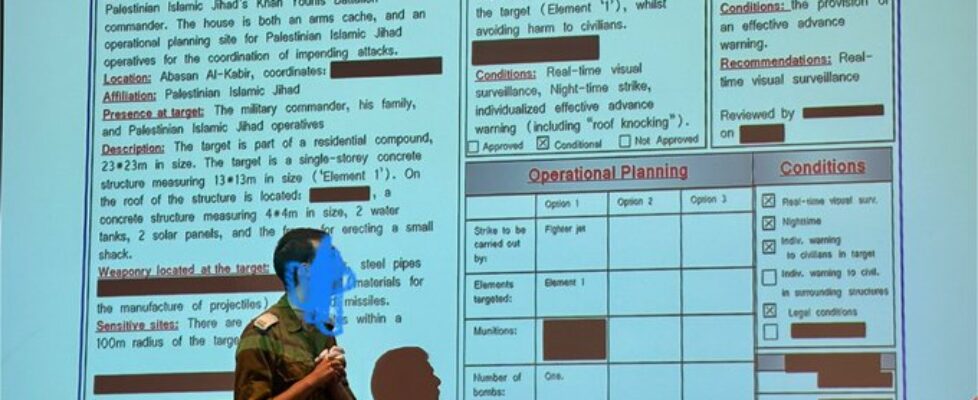
In any event, the miliary lawyer who spoke to us provided a slide, translated from the Hebrew, showing the process required for approving an air strike. The obvious question that may come to mind is that if the targeting is so precise, why has there been so much destruction of Gaza’s infrastructure. And the answer is that Hamas’s vast tunnel network had entrances and exits just everywhere, and Israeli ground forces couldn’t operate safely if Hamas combatants could pop out of a tunnel any time, any place. So the tunnels had to be neutralized, and the only way to neutralize a tunnel below ground was first destroy the building on top of it. Hamas’s use of civilian infrastructure in this manner was both immoral and illegal, and promising solutions like flooding the tunnels were ultimately untenable.

The post How Israeli Lawyers Vet Bombing Targets appeared first on Reason.com.
