Lessons Learned from Upgrading to LangChain 1.0 in Production

What worked, what broke, and why I did it The post Lessons Learned from Upgrading to LangChain 1.0 in Production appeared first on Towards Data Science.
Like
0
Liked
Liked

What worked, what broke, and why I did it The post Lessons Learned from Upgrading to LangChain 1.0 in Production appeared first on Towards Data Science.
Autonomous vehicle (AV) stacks are evolving from many distinct models to a unified, end-to-end architecture that executes driving actions directly from sensor data. This transition to using larger models is drastically increasing the demand for high-quality, physically based sensor data for training, testing and validation. To help accelerate the development of next-generation AV architectures, NVIDIA today released NVIDIA Cosmos Predict-2 — a new world foundation model with improved future world state prediction capabilities for high-quality synthetic data generation […]
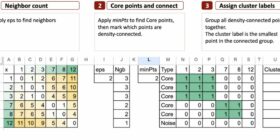
DBSCAN shows how far we can go with a very simple idea: count how many neighbors live close to each point. It finds clusters and marks anomalies without any probabilistic model, and it works beautifully in Excel. But because it relies on one fixed radius, HDBSCAN is needed to make the method robust on real data. The post The Machine Learning “Advent Calendar” Day 10: DBSCAN in Excel appeared first on Towards Data Science.

Leona Health built an AI co-pilot to manage the flood of patient messages Latin American doctors receive on WhatsApp.
Machine-learning models can speed up the discovery of new materials by making predictions and suggesting experiments. But most models today only consider a few specific types of data or variables. Compare that with human scientists, who work in a collaborative environment and consider experimental results, the broader scientific literature, imaging and structural analysis, personal experience or intuition, and input from colleagues and peer reviewers. Now, MIT researchers have developed a method for optimizing materials recipes and planning experiments […]
OpenAI is collaborating with Deutsche Telekom to bring advanced, multilingual AI experiences to millions of people across Europe. ChatGPT Enterprise will also be deployed to help employees at Deutsche Telekom improve workflows and accelerate innovation.
At GTC Paris — held alongside VivaTech, Europe’s largest tech event — NVIDIA founder and CEO Jensen Huang delivered a clear message: Europe isn’t just adopting AI — it’s building it. “We now have a new industry, an AI industry, and it’s now part of the new infrastructure, called intelligence infrastructure, that will be used by every country, every society,” Huang said, addressing an audience gathered online and at the iconic Dôme de Paris. From exponential inference growth […]

Computer-Aided Design (CAD) is the go-to method for designing most of today’s physical products. Engineers use CAD to turn 2D sketches into 3D models that they can then test and refine before sending a final version to a production line. But the software is notoriously complicated to learn, with thousands of commands to choose from. To be truly proficient in the software takes a huge amount of time and practice. MIT engineers are looking to ease CAD’s learning […]

Key Highlights: Google, as we know, has intensified AI features push in the last few months. Now, the Mountain View giant is experimenting with a new approach around how AI can boost productivity. But, this time it lives directly in your inbox. Yes, you read that right. Google’s new experimental AI feature “CC” gives your day’s plan every morning Today, the company quietly launched an experimental assistant called CC, and it’s now available via Google Labs. The only […]
In part 2 of our two-part series on generative artificial intelligence’s environmental impacts, MIT News explores some of the ways experts are working to reduce the technology’s carbon footprint. The energy demands of generative AI are expected to continue increasing dramatically over the next decade. For instance, an April 2025 report from the International Energy Agency predicts that the global electricity demand from data centers, which house the computing infrastructure to train and deploy AI models, will more than double by […]