4 highlights from Google Beam in 2025

Google Beam, our first true-to-life 3D video communication platform, made great progress in 2025.
Like
0
Liked
Liked
Google Beam, our first true-to-life 3D video communication platform, made great progress in 2025.
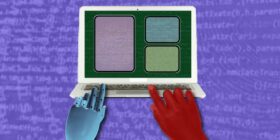
Coding with large language models (LLMs) holds huge promise, but it also exposes some long-standing flaws in software: code that’s messy, hard to change safely, and often opaque about what’s really happening under the hood. Researchers at MIT’s Computer Science and Artificial Intelligence Laboratory (CSAIL) are charting a more “modular” path ahead. Their new approach breaks systems into “concepts,” separate pieces of a system, each designed to do one job well, and “synchronizations,” explicit rules that describe exactly […]

For the first time, developers can embed Google’s Deep Research tool, based on Gemini 3 Pro, into their own apps.
Post Content
submitted by /u/Knorssman [link] [comments]
This article introduces the Gaussian Mixture Model as a natural extension of k-Means, by improving how distance is measured through variances and the Mahalanobis distance. Instead of assigning points to clusters with hard boundaries, GMM uses probabilities learned through the Expectation–Maximization algorithm – the general form of Lloyd’s method. Using simple Excel formulas, we implement EM step by step in 1D and 2D, and we visualise how the Gaussian curves or ellipses move during training. The means shift, […]
Learn more about Google Photos Recap — now available for 2025 — and how you can explore, customize and share it today.
It’s hard to keep up with the ever-changing trends of the fashion world. What’s “in” one minute is often out of style the next season, potentially causing you to re-evaluate your wardrobe. Staying current with the latest fashion styles can be wasteful and expensive, though. Roughly 92 million tons of textile waste are produced annually, including the clothes we discard when they go out of style or no longer fit. But what if we could simply reassemble our clothes […]

Introduction How do we identify latent groups of patients in a large cohort? How can we find similarities among patients that go beyond the well-known comorbidity clusters associated with specific diseases? And more importantly, how can we extract quantitative signals that can be analyzed, compared, and reused across different clinical scenarios? The information associated to […] The post Spectral Community Detection in Clinical Knowledge Graphs appeared first on Towards Data Science.