Gradient Canvas: Celebrating over a decade of artistic collaborations with AI

Gradient Canvas is a new art exhibition celebrating a decade of creative collaborations between artists and artificial intelligence.
Like
0
Liked
Liked
Gradient Canvas is a new art exhibition celebrating a decade of creative collaborations between artists and artificial intelligence.
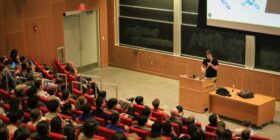
More than 300 people across academia and industry spilled into an auditorium to attend a BoltzGen seminar on Thursday, Oct. 30, hosted by the Abdul Latif Jameel Clinic for Machine Learning in Health (MIT Jameel Clinic). Headlining the event was MIT PhD student and BoltzGen’s first author Hannes Stärk, who had announced BoltzGen just a few days prior. Building upon Boltz-2, an open-source biomolecular structure prediction model predicting protein binding affinity that made waves over the summer, BoltzGen (officially released on Sunday, […]
submitted by /u/JamesParkes [link] [comments]
Post Content
Google is closing an old gap between Kaggle and Colab. Colab now has a built in Data Explorer that lets you search Kaggle datasets, models and competitions directly inside a notebook, then pull them in through KaggleHub without leaving the editor. What Colab Data Explorer actually ships? Kaggle announced the feature recently where they describe a panel in the Colab notebook editor that connects to Kaggle search. From this panel you can: Search Kaggle datasets, models and competitions […]

Deepening our partnership with the UK government to support prosperity and security in the AI era
We’re bringing Gemini’s state-of-the-art translation model to Google Translate for text, and more new features.
Both Google and Apple are cramming new AI features into their phones and other devices, and neither company has offered clear ways to control which apps those AI systems can access. Recent issues around WhatsApp on both Android and iPhone demonstrate how these interactions can go sideways, risking revealing chat conversations beyond what you intend. Users deserve better controls and clearer documentation around what these AI features can access. After diving into how Google Gemini and Apple Intelligence […]
Dimensionality reduction techniques like PCA work wonderfully when datasets are linearly separable—but they break down the moment nonlinear patterns appear. That’s exactly what happens with datasets such as two moons: PCA flattens the structure and mixes the classes together. Kernel PCA fixes this limitation by mapping the data into a higher-dimensional feature space where nonlinear patterns become linearly separable. In this article, we’ll walk through how Kernel PCA works and use a simple example to visually compare PCA […]
GPT-5.2 is our most advanced frontier model for everyday professional work, with state-of-the-art reasoning, long-context understanding, coding, and vision. Use it in ChatGPT and the OpenAI API to power faster, more reliable agentic workflows.