1X struck a deal to send its ‘home’ humanoids to factories and warehouses

Despite launching as a humanoid robot designed to help consumers around the house, 1X’s NEO robots are heading to industrial use cases.
Like
0
Liked
Liked

Despite launching as a humanoid robot designed to help consumers around the house, 1X’s NEO robots are heading to industrial use cases.
Learn more about using Google products like Gemini, Search, Shopping, Pixel and more over the holidays.
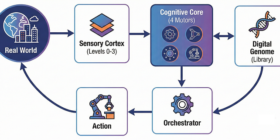
Author(s): Carlos Eduardo Favini Originally published on Towards AI. By Carlos Eduardo Favini Industrial AI — Image by Author 1. The Semantic Ceiling: Why Industrial AI Stalls After two decades of investment, roughly 70% of digital transformation initiatives fail to scale beyond pilot stages (McKinsey, 2023). Industry 4.0 delivered connectivity — sensors, networks, data lakes — but not cognition. The result: dashboards that monitor but don’t decide, models that predict but don’t understand, and automation that breaks when […]

Artificial intelligence is changing the way businesses store and access their data. That’s because traditional data storage systems were designed to handle simple commands from a handful of users at once, whereas today, AI systems with millions of agents need to continuously access and process large amounts of data in parallel. Traditional data storage systems now have layers of complexity, which slows AI systems down because data must pass through multiple tiers before reaching the graphical processing units […]

This article is divided into four parts; they are: • How Logits Become Probabilities • Temperature • Top- k Sampling • Top- p Sampling When you ask an LLM a question, it outputs a vector of logits.
Learn how to make a newsletter with AI tools The post How to Create an ML-Focused Newsletter appeared first on Towards Data Science.
At this point, Google and OpenAI are battling it out neck to neck in terms of AI models. Earlier today, we reported that Google is finalizing an affordable image generation model that offers somewhat similar image quality as the Nano Banana Pro model. Here, the image generation model in question is the Nano Banana 2 Flash, and it will reportedly be powered by Gemini 3 Flash. OpenAI is reportedly testing a new AI image model Now, OpenAI appears […]

Announcing: 𝗪𝗪-𝗣𝗚𝗗 — 𝗪𝗲𝗶𝗴𝗵𝘁𝗪𝗮𝘁𝗰𝗵𝗲𝗿 𝗣𝗿𝗼𝗷𝗲𝗰𝘁𝗲𝗱 𝗚𝗿𝗮𝗱𝗶𝗲𝗻𝘁 𝗗𝗲𝘀𝗰𝗲𝗻𝘁 I just released WW-PGD, a small PyTorch add-on that wraps standard optimizers (SGD, Adam, AdamW, etc.) and applies an epoch-boundary spectral projection using WeightWatcher diagnostics. Elevator pitch: WW-PGD explicitly nudges each layer toward the Exact Renormalization Group (ERG) critical manifold during training. 𝗧𝗵𝗲𝗼𝗿𝘆 𝗶𝗻 𝘀𝗵𝗼𝗿𝘁 • HTSR critical condition: α ≈ 2 • SETOL ERG condition: trace-log(λ) over the spectral tail = 0 WW-PGD makes these explicit optimization targets, rather than […]
I watch a lot of nature documentaries. I’m not very choosy about the animals covered, whether whales, moles, lions, ants, chameleons, blowfish, or mosquitoes. I’m even fascinated by footage of bacteria under a microscope. I’m usually immersed as I sit in front of my large-screen television, so long as I learn something about the intricacies of the species filmed in vibrant colors. What do they eat and how do they avoid being eaten? What are their life expectancies, […]
What if you could build a secure, scalable RAG+LLM system – no GPU, no latency, no hallucinations? In this session, Vincent Granville shares how to engineer high-performance, agentic multi-LLMs from scratch using Python. Learn how to rethink everything from token chunking to sub-LLM selection to create AI systems that are explainable, efficient, and designed for enterprise-scale applications. What you’ll learn: How to build LLM systems without deep neural nets or GPUs Real-time fine-tuning, self-tuning, and context-aware retrieval Best […]