Was the Big Unread Bill a poison pill?

Will it destroy federal legitimacy The post Was the Big Unread Bill a poison pill? appeared first on Downsize DC.
Like
0
Liked
Liked
Will it destroy federal legitimacy The post Was the Big Unread Bill a poison pill? appeared first on Downsize DC.
I frequently refer to OpenAI and the likes as LLM 1.0, by contrast to our xLLM architecture that I present as LLM 2.0. Over time, I received a lot of questions. Here I address the main differentiators. First, xLLM is a no-Blackbox, secure, auditable, double-distilled agentic LLM/RAG for trustworthy Enterprise AI, using 10,000 fewer (multi-)tokens, no vector database but Python-native, fast nested hashes in its original version, and no transformer to generate the structured output to a prompt. […]
Standard LLMs rely on prompt engineering to fix problems (hallucinations, poor response, missing information) that come from issues in the backend architecture. If the backend (corpus processing) is properly built from the ground up, it is possible to offer a full, comprehensive answer to a meaningful prompt, without the need for multiple prompts, rewording your query, having to go through a chat session, or prompt engineering. In this article, I explain how to do it, focusing on enterprise […]

The letter demanded companies institute new safeguards to keep users safe from harmful psychological impacts.
This Thanksgiving, I give thanks for something our forebears gave us: property rights.
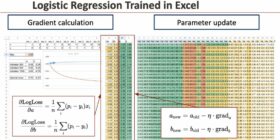
In this article, we rebuild Logistic Regression step by step directly in Excel. Starting from a binary dataset, we explore why linear regression struggles as a classifier, how the logistic function fixes these issues, and how log-loss naturally appears from the likelihood. With a transparent gradient-descent table, you can watch the model learn at each iteration—making the whole process intuitive, visual, and surprisingly satisfying. The post The Machine Learning “Advent Calendar” Day 12: Logistic Regression in Excel appeared […]

The U.S. Department of Energy’s National Nuclear Security Administration (DOE/NNSA) recently announced that it has selected MIT to establish a new research center dedicated to advancing the predictive simulation of extreme environments, such as those encountered in hypersonic flight and atmospheric re-entry. The center will be part of the fourth phase of NNSA’s Predictive Science Academic Alliance Program (PSAAP-IV), which supports frontier research advancing the predictive capabilities of high-performance computing for open science and engineering applications relevant to national security […]
Isolation Forest may look technical, but its idea is simple: isolate points using random splits. If a point is isolated quickly, it is an anomaly; if it takes many splits, it is normal. Using the tiny dataset 1, 2, 3, 9, we can see the logic clearly. We build several random trees, measure how many splits each point needs, average the depths, and convert them into anomaly scores. Short depths become scores close to 1, long depths close […]

Introduction How do we identify latent groups of patients in a large cohort? How can we find similarities among patients that go beyond the well-known comorbidity clusters associated with specific diseases? And more importantly, how can we extract quantitative signals that can be analyzed, compared, and reused across different clinical scenarios? The information associated to […] The post Spectral Community Detection in Clinical Knowledge Graphs appeared first on Towards Data Science.

A robot searching for workers trapped in a partially collapsed mine shaft must rapidly generate a map of the scene and identify its location within that scene as it navigates the treacherous terrain. Researchers have recently started building powerful machine-learning models to perform this complex task using only images from the robot’s onboard cameras, but even the best models can only process a few images at a time. In a real-world disaster where every second counts, a search-and-rescue […]