Moving Beyond the Slow, Hierarchical Organization

A conversation with author Jana Werner about how companies must adapt their processes to survive continuous transformation.
Like
0
Liked
Liked

A conversation with author Jana Werner about how companies must adapt their processes to survive continuous transformation.
Can a 3B model deliver 30B class reasoning by fixing the training recipe instead of scaling parameters? Nanbeige LLM Lab at Boss Zhipin has released Nanbeige4-3B, a 3B parameter small language model family trained with an unusually heavy emphasis on data quality, curriculum scheduling, distillation, and reinforcement learning. The research team ships 2 primary checkpoints, Nanbeige4-3B-Base and Nanbeige4-3B-Thinking, and evaluates the reasoning tuned model against Qwen3 checkpoints from 4B up to 32B parameters. https://arxiv.org/pdf/2512.06266 Benchmark results On AIME […]
Zhipu AI has open sourced the GLM-4.6V series as a pair of vision language models that treat images, video and tools as first class inputs for agents, not as afterthoughts bolted on top of text. Model lineup and context length The series has 2 models. GLM-4.6V is a 106B parameter foundation model for cloud and high performance cluster workloads. GLM-4.6V-Flash is a 9B parameter variant tuned for local deployment and low latency use. GLM-4.6V extends the training context […]
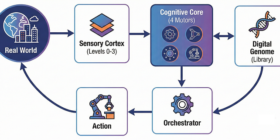
Author(s): Carlos Eduardo Favini Originally published on Towards AI. By Carlos Eduardo Favini Industrial AI — Image by Author 1. The Semantic Ceiling: Why Industrial AI Stalls After two decades of investment, roughly 70% of digital transformation initiatives fail to scale beyond pilot stages (McKinsey, 2023). Industry 4.0 delivered connectivity — sensors, networks, data lakes — but not cognition. The result: dashboards that monitor but don’t decide, models that predict but don’t understand, and automation that breaks when […]
Autonomous vehicle (AV) stacks are evolving from many distinct models to a unified, end-to-end architecture that executes driving actions directly from sensor data. This transition to using larger models is drastically increasing the demand for high-quality, physically based sensor data for training, testing and validation. To help accelerate the development of next-generation AV architectures, NVIDIA today released NVIDIA Cosmos Predict-2 — a new world foundation model with improved future world state prediction capabilities for high-quality synthetic data generation […]
In this tutorial, we build an advanced meta-cognitive control agent that learns how to regulate its own depth of thinking. We treat reasoning as a spectrum, ranging from fast heuristics to deep chain-of-thought to precise tool-like solving, and we train a neural meta-controller to decide which mode to use for each task. By optimizing the trade-off between accuracy, computation cost, and a limited reasoning budget, we explore how an agent can monitor its internal state and adapt its […]
As AI systems begin handling more complex, multi-stage tasks, understanding agentic design is becoming essential. This article outlines seven practical steps to build reliable, effective AI agents.

OpenAI just launched GPT-5.2, a frontier model aimed at developers and professionals, pushing reasoning and coding benchmarks as it races Google’s Gemini 3 while grappling with compute costs and no generator.

Empromptu claims all a user has to do is tell the platform’s AI chatbot what they want — like a new HTML or JavaScript app — and the AI will go ahead and build it.
USDA Secretary Rollins promised “structural changes” to SNAP this week amid concerns about widespread fraud in the program. Major reforms to SNAP’s financing model cannot be made without Congress, but USDA can help enforce the program’s eligibility standards by closing a loophole that has allowed millionaires, lottery winners, and households with six-figure assets to receive SNAP benefits through regulation. lead , In a recent blog post titled The SNAP Loophole that Lets Millionaires Receive Food Stamps, the director […]